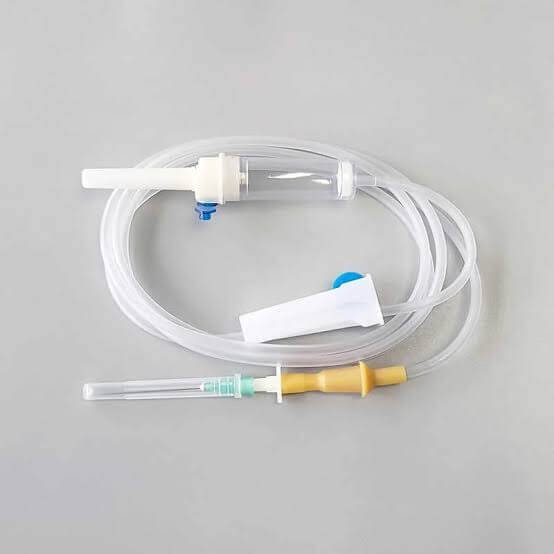
For those newer to clinical practice or medical device education, understanding exactly what constitutes a complete infusion set, and how its various components work together as an integrated system, provides essential foundational knowledge for safe, effective intravenous therapy practice.
Defining the Complete Infusion Set
An infusion set refers to the complete assembly of connected components that together enable controlled fluid delivery from a source container, typically an IV bag, through to a patient’s vascular access point, encompassing everything from the initial bag connection through flow control mechanisms and finally the patient connection itself.
The System Perspective Versus Individual Components
While it’s valuable to understand each individual component, including the spike, drip chamber, roller clamp, and injection ports, appreciating how these pieces function together as an integrated system provides a more complete and clinically useful understanding than considering any single component in isolation.
How Fluid Moves Through the Complete System
Understanding infusion set function benefits from tracing the complete fluid pathway, beginning with gravity or pump-driven flow from the source bag through the spike connection, continuing through the drip chamber where flow becomes visually observable, passing through the roller clamp where rate control occurs, potentially through one or more injection ports, and finally reaching the patient through the terminal connector and vascular access device.
Variations in Infusion Set Design for Different Applications
Different clinical applications call for different infusion set configurations, including standard sets for routine fluid administration, specialized sets incorporating volumetric chambers for pediatric or precision-dosing applications, and sets designed specifically for blood product administration incorporating appropriate filtration elements.
Gravity-Fed Versus Pump-Compatible Set Designs
Infusion sets need to be compatible with their intended delivery method, whether gravity-fed administration relying on roller clamp adjustment for rate control, or pump-compatible designs intended for use with electronic infusion pumps that provide more precise, automated flow rate control and monitoring.
See also: Wearable Health Monitoring Systems
The Role of Complete System Validation
Manufacturers producing infusion sets need to validate performance of the complete assembled system, confirming that individually well-designed components actually function reliably together throughout the product’s intended shelf life and clinical use conditions, rather than validating components purely in isolation.
Building Comprehensive Clinical Competency
Clinical education benefits from helping staff understand both individual component function and complete system operation, supporting comprehensive competency that enables confident handling of routine infusion therapy tasks along with effective troubleshooting when unexpected situations arise.
Conclusion
Understanding what constitutes a complete infusion set, and how its various components function together as an integrated fluid delivery system, provides essential foundational knowledge for safe, confident clinical practice. This systems-level understanding complements knowledge of individual components to support comprehensive clinical competency.
FAQs
Q1: What does a complete infusion set encompass? The complete assembly of connected components enabling controlled fluid delivery from a source container through to a patient’s vascular access point, including all flow control and connection components.
Q2: How do infusion sets vary for different clinical applications? Variations include standard sets for routine use, specialized sets with volumetric chambers for precision dosing, and sets designed specifically for blood product administration with appropriate filtration.
Q3: Why must infusion sets be matched to their intended delivery method? Sets need compatibility with either gravity-fed administration relying on manual roller clamp control, or pump-compatible designs intended for electronic infusion pump use.