Introduction
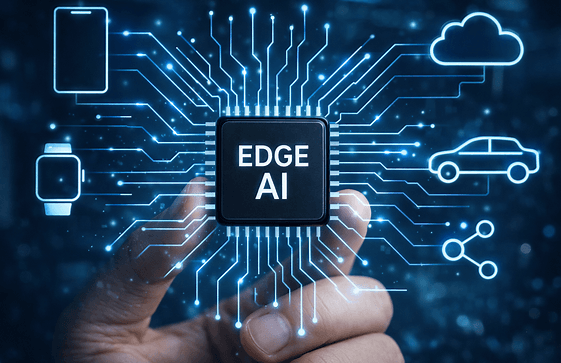
Artificial intelligence is evolving faster than ever, and one of the biggest innovations driving this transformation is Edge AI. Unlike traditional AI systems that rely on cloud computing, Edge AI processes data directly on devices such as smartphones, security cameras, wearable technology, autonomous vehicles, and industrial machines. This localized processing enables faster decision-making, stronger privacy, and greater reliability.
As the number of connected devices continues to grow, Edge AI is becoming the foundation of the next generation of smart technology. Businesses and consumers alike are embracing this technology because it delivers real-time intelligence without depending entirely on internet connectivity. In this article, you’ll learn what Edge AI is, how it works, and why it is shaping the future of smart devices.
What Is Edge AI?
Edge AI is the combination of artificial intelligence and edge computing. Instead of sending data to remote cloud servers for processing, Edge AI allows devices to analyze and respond to information locally. This means that AI models run directly on the hardware where the data is generated.
For example, a smart security camera equipped with Edge AI can recognize a person, detect suspicious activity, and send an alert instantly without uploading every video frame to the cloud. This local processing reduces delays and improves overall system performance.
Why Edge AI Is Becoming Essential
Modern smart devices generate enormous amounts of data every second. Sending all of this information to cloud servers can increase latency, consume significant bandwidth, and create privacy concerns.
Edge AI solves these challenges by processing information closer to its source. The result is faster response times, lower operating costs, and a better user experience. As AI chips become more powerful and energy efficient, manufacturers are integrating Edge AI into a growing range of consumer and industrial devices.
Real-Time Decision Making
One of the greatest advantages of Edge AI is its ability to make decisions instantly. Since information is processed locally, devices do not need to wait for instructions from remote servers.
Autonomous vehicles are an excellent example. They must recognize pedestrians, traffic signs, and nearby vehicles within milliseconds to ensure safe driving. Any delay in processing could lead to dangerous situations. Edge AI enables these vehicles to react immediately, making transportation safer and more reliable.
The same principle applies to smart factories, healthcare devices, and home automation systems where immediate responses are critical.
Enhanced Privacy and Security
Data privacy has become one of the biggest concerns in the digital world. Many users worry about their personal information being stored on external servers.
Edge AI addresses this issue by keeping sensitive information on the device whenever possible. Facial recognition, voice commands, health records, and biometric data can all be processed locally without unnecessary transmission across the internet.
This approach significantly reduces the risk of data breaches while helping organizations comply with modern privacy regulations.
Reduced Internet Dependence
Cloud-based AI systems require stable internet connections to function effectively. However, many environments have unreliable or limited connectivity.
Edge AI allows devices to continue operating even when internet access is unavailable. Smart agricultural equipment, industrial robots, medical devices, and remote monitoring systems can continue making intelligent decisions without interruption.
This reliability makes Edge AI especially valuable in locations where network coverage cannot always be guaranteed.
Edge AI in Smart Homes
Smart homes are becoming more intelligent thanks to Edge AI. Devices such as smart speakers, thermostats, lighting systems, security cameras, and home assistants can process commands directly without relying heavily on cloud services.
This leads to faster voice recognition, improved automation, and enhanced privacy. Homeowners experience quicker responses while maintaining greater control over their personal data.
As connected homes continue to evolve, Edge AI will become an increasingly important part of everyday living.
Transforming Healthcare
Healthcare is another industry benefiting from Edge AI. Wearable devices can monitor heart rate, blood oxygen levels, sleep quality, and other vital signs while analyzing data in real time.
Doctors receive immediate alerts when abnormal readings occur, allowing faster medical intervention. Hospitals also use Edge AI in diagnostic imaging systems to assist healthcare professionals in detecting diseases more efficiently.
These innovations improve patient care while reducing delays associated with cloud-based processing.
Smarter Manufacturing and Industry
Manufacturing companies are using Edge AI to improve productivity and reduce operational costs. Intelligent sensors continuously monitor equipment performance, identifying potential problems before they cause expensive downtime.
Predictive maintenance powered by Edge AI helps businesses repair machinery before failures occur. Automated quality control systems can also detect production defects instantly, improving manufacturing accuracy and reducing waste.
These capabilities make factories more efficient and competitive in today’s fast-changing industrial landscape.
Challenges of Edge AI
Although Edge AI offers numerous benefits, it also presents technical challenges. Running advanced AI models on small devices requires specialized processors and optimized software. Manufacturers must balance performance, battery life, and hardware costs while maintaining reliable AI capabilities.
Cybersecurity is another important consideration. While local processing improves privacy, connected devices still require regular software updates and strong security measures to protect against cyber threats.
Fortunately, rapid advances in AI hardware continue to overcome many of these limitations.
The Future of Edge AI
The future of Edge AI looks incredibly promising. As processors become faster and more energy efficient, billions of connected devices will gain advanced AI capabilities. Smart cities, autonomous transportation, industrial automation, healthcare, retail, and consumer electronics will all benefit from intelligent local processing.
The expansion of 5G networks will further strengthen Edge AI by enabling seamless communication between local devices and cloud platforms when additional computing power is needed.
Over the next decade, Edge AI is expected to become a core technology powering nearly every intelligent device we use.
See also: Wearable Technology and Privacy Concerns
Conclusion
Edge AI is revolutionizing the way smart devices operate by bringing artificial intelligence closer to the source of data. With faster processing, lower latency, enhanced privacy, and reduced dependence on cloud computing, it is enabling a new generation of intelligent products that are faster, smarter, and more secure.
From autonomous vehicles and wearable technology to smart homes and industrial automation, Edge AI is transforming industries and improving everyday life. As artificial intelligence continues to evolve, Edge AI will remain one of the most important technologies driving innovation and shaping the future of connected devices.