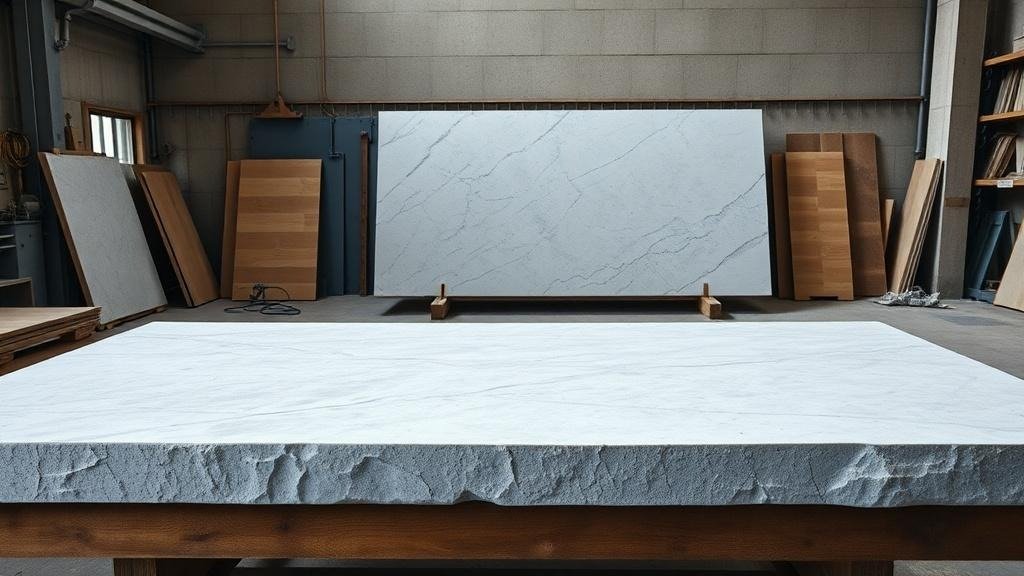
The practical test for countertop fabrication is whether it helps a shop quote faster, waste less material, and avoid preventable mistakes on real jobs. Anything else is just software theater.
Last fall I spent a morning in a shop outside Toledo with a guy named Gary who runs six employees, two bridge saws (one of them a 2004 Park Yukon he refuses to let go of), and a Northwood C-12 he financed in 2023. Gary’s callback rate was hovering around 13 percent. His yield was sitting at maybe 61 percent. He was busy, booking 22 to 28 jobs a week, and still couldn’t figure out why he was clearing less than eight cents on the dollar after install. His exact words: “I’m running my ass off to break even.”
Gary’s problem wasn’t demand. It was that he treated fabrication like one big blob of work instead of what it actually is: eight distinct workstations, each with its own cost structure, tooling requirements, skill dependencies, and failure modes. The shops that understand this distinction tend to hit 14 to 22 percent net margin and callback rates under 4 percent. The shops that don’t? They end up like Gary was, working harder and keeping less.
Countertop fabrication is the production discipline that converts a raw slab into an installed, sealed, signed-off kitchen or vanity surface. That’s it. But inside that simple description lives a production chain that, when run with discipline, separates profitable shops from shops that are just busy.
The Eight Workstations (and Where Margin Actually Leaks)
Every fabrication job moves through eight connected steps. Here’s the sequence:
Slab receiving. Inspection, color verification, defect tagging, inventory entry. A clean slab yard tags each piece with a unique ID, color batch, and dimensional notes. Shops that skip this step pay for it later when a vein mismatch shows up at install.
Templating. Field measurement captured via laser, photogrammetric, or LiDAR hardware. Output is a CAD file (DXF, DWG, or STEP). Hand templating still works at older shops when done with real discipline, but it’s slower and more error-prone.
Nesting. Templated parts arranged onto specific slabs with vein matching, seam policy, and remnant tracking. Output is a CAM file ready for the saw. This is where yield lives or dies.
Sawing. Rough cuts on a bridge saw. Throughput runs roughly 4 to 8 minutes per part on standard kitchens.
CNC profiling. Edge profiles, cutouts, finish polish. CNC edge profiles run between 6 and 14 minutes per linear foot depending on tooling and material density.
Polishing. Edge and surface finishing to spec. Hand polishing supplements CNC on detail work.
Install staging. Seam prep, hardware installation, transport protection.
Field install. Loadout, transport, dry fit, leveling, seam application, sealant, final walkthrough.
The boring truth is that most margin leaks happen in just two or three of these stations. Quoting (accuracy and time), nesting (yield), and install (callbacks) are the usual culprits. Gary’s shop was hemorrhaging in all three.
See also: Wearable Technology and Privacy Concerns
The Numbers That Matter in 2026
Some baseline specs worth keeping visible on the wall:
- Standard slab dimensions for quartz and granite run roughly 56 by 120 inches in 2cm or 3cm thickness.
- A typical residential shop processes 18 to 40 jobs per week, with average job sizes between 45 and 75 square feet.
- Yield in a disciplined nesting program runs 65 to 78 percent of raw slab area for kitchens with one waterfall side. Most shops I’ve seen sit closer to the low end unless they’re deliberate about it.
- Edge flatness tolerance on disciplined CNC operations: 0.005 inch.
- Cabinet leveling tolerance: 1/16 inch over 24 inches of run.
- Seam adhesive cure time: 25 to 40 minutes at 70 degrees Fahrenheit.
- Template-to-install timeline: 7 to 14 calendar days. Rework on failed seams or cutouts adds 5 to 9 days.
- Cost per square foot installed: $55 to $130 for quartz, $38 to $115 for granite.
- Revenue per employee benchmark: $185,000 to $260,000 in residential markets.
That last number is worth sitting with. If your six-person shop is doing $900K in revenue, you’re below floor. Something structural is off.
Where the Money Shows Up
Returns from disciplined fabrication show up in three places, and all of them are measurable.
Material cost savings. Moving from 60 percent yield to 75 percent yield at a $2M residential shop frees up to $40,000 per year in slab cost. That’s not theoretical. That’s what disciplined nesting does. Think of nesting like Tetris, except every wasted gap is money left on the slab rack.
Labor savings. Integrated quoting platforms cut quote time from 35 minutes to 14 minutes per job. At a 25-job week, that’s roughly 8 hours freed at the owner level. Eight hours you probably spend quoting instead of managing production.
Rework and callback savings. This is the big one. Cutting callback rate from 12 percent to 4 percent at a 25-jobs-per-week shop saves up to $250,000 per year in rework labor, lost crew time, and the customer goodwill damage that doesn’t show up on a P&L but absolutely shows up in your referral pipeline.
Running the Changeover in 90 to 180 Days
Fixing a shop isn’t a weekend project. It runs in three phases.
Phase 1: Diagnosis (Weeks 1 to 3). Walk each of the eight workstations. Document the current state. Be honest about where the margin leaks are. Most owners already know, they just haven’t quantified the cost. Common leak points: quoting accuracy, nesting yield, and install callbacks.
Phase 2: Tooling (Weeks 4 to 10). Pick the platforms and equipment changes that address your specific leaks. Common moves include adopting a vertical software platform, switching to digital templating, and getting intentional about nesting practice. Generic ERP systems (NetSuite, Sage Intacct, Acumatica) handle financials but need heavy customization for stone workflow. Vertical platforms like Moraware Systemize, StoneApp, ActionFlow, and Slabwise ship with trade-specific workflow built in. Pricing runs $99 to $799 per month depending on shop size. Spreadsheets work at five employees. They stop working at ten. Owners doing serious research on the operational side can find this article useful as a working reference.
Phase 3: Training and tracking (Weeks 8 to 24, overlapping). Each workstation gets documented practice, training time, and weekly metric tracking. Track yield, callback rate, quote turnaround, and quote-to-close conversion. Weekly. Not monthly, not quarterly. Weekly. If you can’t see the number by Tuesday morning, you can’t fix the problem by Friday.
Silica Is Not a Suggestion
I’ll keep this section short because there’s no nuance here.
Stone fabrication generates respirable crystalline silica dust. Cutting, grinding, profiling, and polishing all produce particles in the respirable range. OSHA 29 CFR 1926.1153 sets the permissible exposure limit at 50 micrograms per cubic meter as an 8-hour time-weighted average.
Wet-cutting on bridge saws, CNC routers, and waterjets is the primary engineering control. Local exhaust ventilation on dry operations (hand polishing, finish work) is the second line. Half-mask respirators with P100 filters cover residual risk.
Most trade-active shops in 2026 run quarterly air sampling on representative tasks and keep records on file. If you’re not doing this, you’re one OSHA visit away from a very bad quarter.
My Honest Take on Where Shops Go Wrong
Here’s an opinionated statement: the single biggest mistake I see shop owners make is treating their CNC like a magic box and their nesting like an afterthought. They’ll spend $180K on a machine and then let whoever’s on shift that morning drag parts onto a slab layout in five minutes. That’s like buying a $60,000 truck and never changing the oil. The machine is only as good as what you feed it, and what you feed it comes from nesting.
Owners weighing major operational changes (platform purchase, equipment investment, multi-location expansion) commonly benefit from peer review before committing capital. The Natural Stone Institute and the International Surface Fabricators Association both offer member resources and benchmarking networks. Use them.
Frequently Asked Questions
Q: What kind of warranty do most stone shops offer on residential work? A: Residential stone shops in 2026 typically offer 1-year workmanship and material defect coverage, with sealer warranties varying by material.
Q: How is fabrication margin actually measured at a stone shop? A: Margin is measured per job in dollars per square foot post-install, with material yield, labor hours, and rework backed out to a defendable figure.
Q: What is the typical training time for a new templator at a residential shop? A: Templator training runs 4 to 9 months for residential work, with the first solo template typically supervised.
Q: How long does a typical countertop fabrication job take from template to install? A: Most residential jobs run 7 to 14 calendar days from template to install. Rework on failed seams or cutouts can add 5 to 9 days.
Q: What is the biggest cost driver in countertop fabrication? A: Material is roughly a third of the job cost, but labor across templating, CNC, and install drives total margin more than slab price does on the residential side.
Q: Why do quotes from different shops vary so widely on the same kitchen? A: Shops with disciplined quoting tend to come in 8 to 15 percent below shops that improvise, because their nesting and labor estimates are tighter.
Q: When does a spreadsheet stop working for shop management? A: Most shops hit a hard ceiling between 8 and 12 employees. Beyond that, integration debt accumulates faster than you can patch it with formulas and shared drives.
Stone fabrication generates respirable crystalline silica dust. Shops must follow OSHA 29 CFR 1926.1153 standards (50 ug/m3 PEL over 8-hour shift). Wet-cutting methods, ventilation, and respiratory protection are not optional.